
Cedar County Sex Offender Checks
The Iowa Sex Offender Registry is the first public channel for Cedar County sex offender information. The Iowa Department of Public Safety, Division of Criminal Investigation maintains it. Search by a known name or use county, city, ZIP code, and radius tools for community awareness. The registry is free, statewide, and built to disclose the fields Iowa law makes public. It is not a list kept separately by each city.
The Cedar County Sheriff's Office supplies the local layer. It registers people who reside in Cedar County, accepts required changes, and examines reports of possible nonregistration or an incorrect residence. The registry page is best for a public lookup. The sheriff is the right contact when an entry seems wrong or a compliance issue needs review. Searchers should save the profile date and verify new facts before acting because updates and corrections can take time to reach the public view.
Cedar County Registry Officer
Cedar County uses a direct appointment channel rather than a separate county offender database. A registrant moving into the county must call the registry officer at 563-886-2000 and report required changes within five business days. The Cedar County registry office page explains that local process and gives the public a route for reporting suspected noncompliance or a residence that appears incorrect.
The office works from the Cedar County Law Enforcement Center, where the sheriff and jail are based. Public callers should describe the suspected issue and let trained staff compare the report with the information held by law enforcement. A public profile does not reveal every verification note or compliance action. It also does not give a member of the public authority to investigate a home, confront a person, or enter private land.
Cedar County Registry Officer
711 E. South Street
Tipton, IA 52772
563-886-2000
Call for registration appointments or to report a suspected compliance issue.
The county's official page shows the public-facing local process. Its focused scope helps distinguish a compliance report from a general Cedar County sex offender lookup.
The Cedar County Sheriff's registry guidance can also be seen in the county source below.
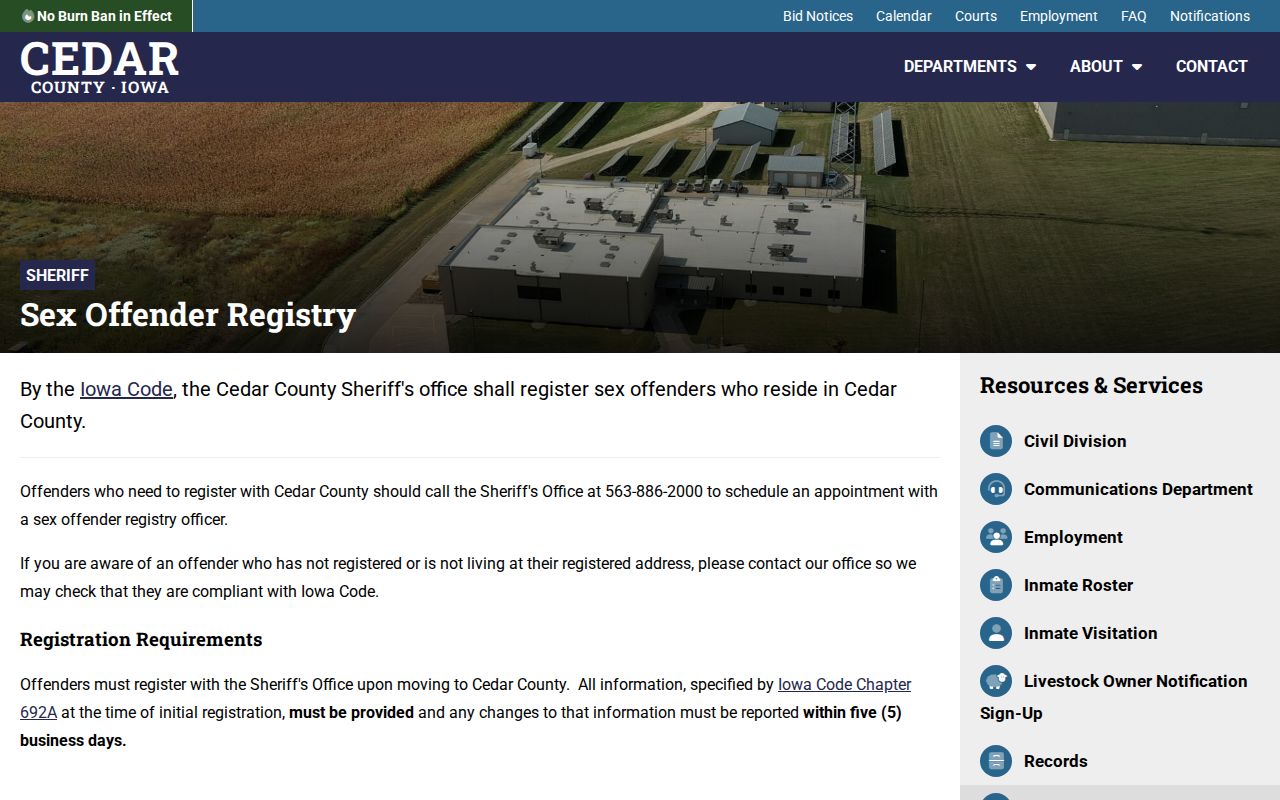
The county screen directs residents to the office that can check local registration facts rather than inviting public confrontation.
Iowa Sex Offender Registry Searches
Iowa Code section 692A.121 requires the public internet search to work by name, county, city, ZIP code, and geographic radius. That range supports two different needs. A name query can help confirm whether a known person has a public profile, while a Cedar County or radius search supports neighborhood awareness. Aliases may be shown on a profile, so the full profile deserves review when a result seems close.
- Open the Iowa registry and read the public-use terms before continuing.
- Enter a known name, or select Cedar County and add a city, ZIP code, or geographic radius.
- Review the result list without relying only on a similar name, photo, or map point.
- Open the matching profile and read the registration status, address information, offense details, and update information together.
Start with the narrowest facts that are reliable. If a spelling is uncertain, place tools may help, but they can return many entries. Reset the form before changing from a name query to a broad geographic search so an old filter does not hide a Cedar County result.
| Field Label | Type | Required | Notes |
|---|---|---|---|
| Name | Text | No | Useful for a known person; aliases may appear in the profile. |
| County | Dropdown | No | Select Cedar for a county-wide result set. |
| City | Text or dropdown | No | Narrows results to a municipality. |
| ZIP code | Text | No | Uses a five-digit geographic filter. |
| Geographic radius | Number, dropdown, or map | No | Searches around the location entered. |
| Search or Reset | Buttons | Not applicable | Use Reset before building a new query. |
The official Iowa registry search displays the search and notice interface captured below.
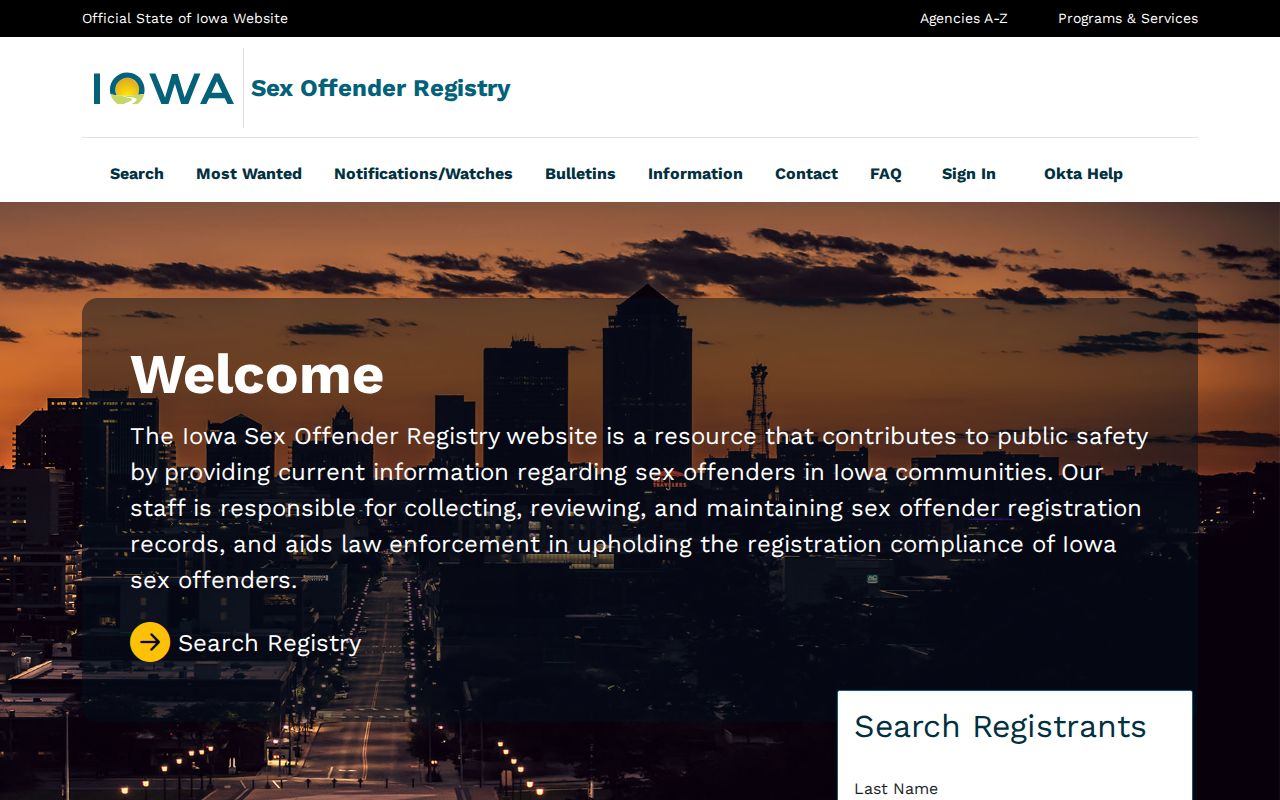
The state interface is the authoritative public starting point for Cedar County filters and individual public profiles.
Cedar Registry Updates in Five Days
Iowa law ties registry usefulness to prompt reporting. Cedar County registrants must report required changes within five business days, and corrected or updated information must be supplied to the public registry within the statutory period. That timing matters when someone has recently moved, changed work or school information, or corrected a profile field. A search made during the update window can show an older fact.
When precision matters, record the date of the lookup and check the profile again after the update period. Suspected errors should go to the Cedar County sheriff for a compliance check. The public should not treat a delayed change as proof of a new offense. Law enforcement can compare the report with nonpublic registration records, contact the registrant when authorized, and decide whether more investigation is needed.
Note: A recent move and an incorrect public address can look alike until the Cedar County registry officer verifies the facts.
Registry Profiles: What They Show
A Cedar County registry profile brings together identity, location, registration, and offense data that Iowa law allows the public to see. Under section 692A.121, public information includes a person's name, nicknames or aliases, date of birth, photographs, physical description, residence, and other designated information. Depending on the person's classification and the governing law, a profile can also display an employer or school, vehicle data, marks or tattoos, and the offense that created the duty to register.
| Name and aliases | Primary name plus public nicknames or alternate names used to help distinguish a result. |
|---|---|
| Photo and description | Public image and physical traits that help avoid a same-name mismatch. |
| Residence or location | The address or location information Iowa law makes public for the profile. |
| Offense information | Conviction or offense details linked to the registration duty. |
| Other public fields | Employer, school, vehicle, scars, marks, or tattoos when disclosure applies. |
| Registration status | Current public status and related registration details shown by the state system. |
These fields need to be read as one record. A photo without the name and birth date can lead to a false match. An address without the offense and registration details can create a false claim about what the listing means. The registry does not publish every law-enforcement note, and the profile is not a complete Cedar County court file. Filed charges, judgment, and sentence remain court records.
National and Cedar Registry Searches
The U.S. Department of Justice operates the National Sex Offender Public Website, known as NSOPW. It combines public information from participating jurisdictions and is useful when a person or location has links outside Iowa. That broader reach makes it a valuable second check, but it does not replace the Iowa registry for Cedar County details.
Iowa's site reflects Iowa disclosure rules and connects more directly to the Cedar County sheriff's local registration role. NSOPW can help spot an out-of-state public listing or widen a geographic search. If the national and state results differ, use the Iowa profile for Iowa-specific fields and ask the sheriff about a suspected local error. Differences may stem from update timing, the search terms used, or what each jurisdiction may display.
The national registry search maintained by the Department of Justice is shown in the source image below.
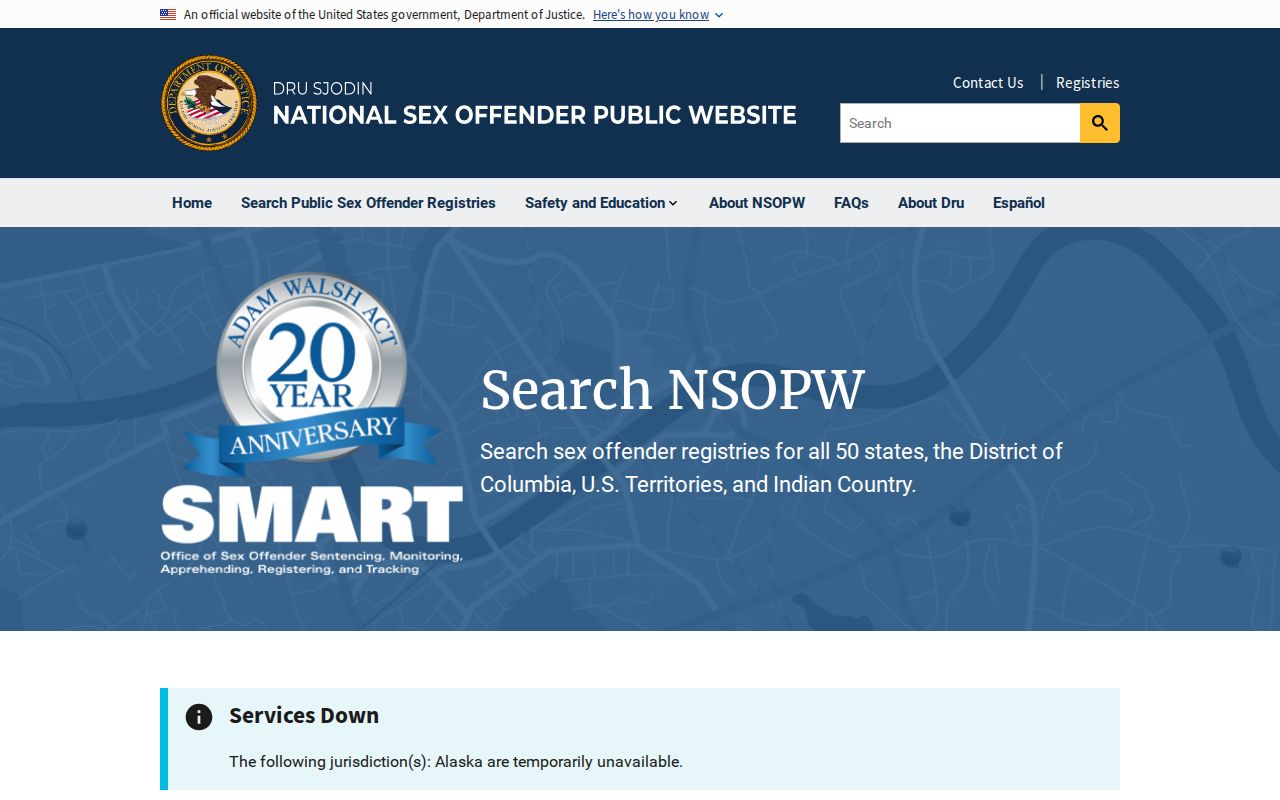
Its cross-state scope adds context, while Iowa's public registry remains the key source for Cedar County registration information.
Registration Levels and Duties in Iowa
Iowa registration is driven by the offense and statutory category, not by a simple public risk score. Searchers should not import another state's Tier I, II, or III labels into a Cedar County profile. Iowa Code chapter 692A controls who registers, the period that applies, and the verification duties associated with a category. Sections 692A.103, 692A.106, and 692A.113 must be read for the specific offense and history.
| Iowa Category | General Duration | Verification Concept |
|---|---|---|
| Offenses subject to ten-year registration | Ten years, with statutory calculation and tolling | Periodic in-person verification under chapter 692A |
| Offenses subject to lifetime registration | Life | Continuing or more frequent verification as the statute assigns |
| Multiple, aggravated, or special categories | Consult sections 692A.103, .106, and .113 | Frequency and duration depend on the offense and classification |
Events listed in Iowa law can affect how the period is calculated or restart the clock. A profile should therefore be read with the actual conviction and current status, not with a guess based on the offense name alone. A person seeking modification of a registration obligation must use the statutory process in section 692A.128. The public search cannot decide eligibility or alter the registration period.
Missing Cedar Registry Results
A missing result can have more than one cause. The name may be entered differently, a location filter may be too narrow, the person may be registered in another Iowa county or state, or the public information may be in an update cycle. Registration duties also depend on the governing offense and statute. The absence of a Cedar County result should not be turned into a claim that someone has evaded the law.
Try a broader Iowa name search, remove an old city or ZIP filter, and use NSOPW when another state may be involved. If reliable facts point to an unreported Cedar County residence, call the sheriff's registry officer. Provide the facts that can be checked without posting a name or accusation publicly. The officer can assess compliance under Iowa law and decide whether the report calls for investigation.
Cedar Registry Pins Need Context
A geographic pin helps with community awareness, but it does not decide whether an address violates Iowa law. Residence restrictions and exclusion zones under Iowa Code section 692A.114 depend on the person's offense and circumstances. Map scale, address placement, property boundaries, and the type of nearby site can also affect what a viewer thinks the map shows.
Report a suspected incorrect Cedar County address to the sheriff. Give the location and the reason it appears wrong, then allow the registry officer to check the record. Do not use a pin as a reason to watch a home, photograph people, trespass, or confront anyone. Those steps can cause harm and may violate the law. For immediate danger, use the proper emergency channel rather than an online registry form.
Note: A registry map supports a search, but only the relevant facts and Iowa law can establish a residence-rule violation.
Using Registry Information Lawfully
Public registry data exists for safety planning and community awareness. A Cedar County family might use it to understand listings near a home, school route, or place they visit. The sound response is to review the state profile, teach practical safety habits, and send suspected noncompliance to the sheriff. The registry does not authorize threats, harassment, trespass, unlawful discrimination, or interference with a registrant or household.
Accuracy also matters. Match the name, aliases, photo, birth date, description, offense, and address before drawing a conclusion. Recheck a recently updated profile and use the Cedar County registry officer when local facts appear wrong. Public access carries a duty to avoid spreading an unverified claim. The current Iowa Code chapter 692A is the primary source for registry duties, disclosure, residence rules, and public-use limits.
Registry misuse warning: Misusing registry information to threaten, harass, intimidate, trespass, or commit another offense can be a crime under Iowa Code chapter 692A. Report concerns to the Cedar County sheriff instead of confronting anyone.
A lawful Cedar County sex offender lookup ends with verification, restraint, and the right official channel. The state portal supplies the public profile. The sheriff checks local compliance. NSOPW expands a search across state lines. None of those sources turns suspicion into proof or permits private enforcement.